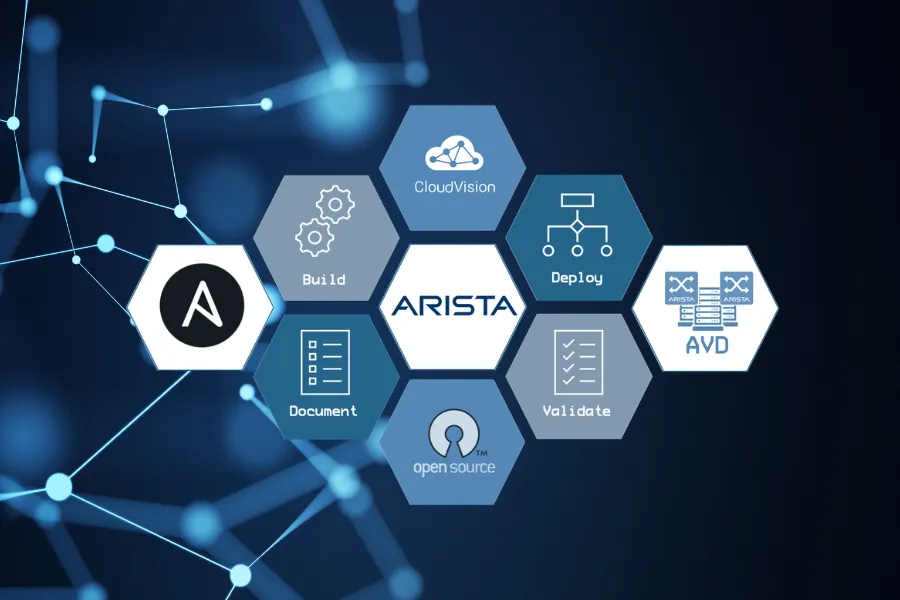
Network Automation in 2026: Beyond Python Scripts (Arista AVD, CloudVision & What to Learn)
Network automation is evolving faster than most engineers realize. If your current toolkit is limited to Python scripts, Ansible playbooks, and basic API integrations, you are already working with the previous generation of tools.
According to Gartner, by 2026, 30% of enterprises will automate more than half of their network activities, a massive jump from under 10% in mid-2023. Arista That growth is not being driven by more Python scripts. It is being driven by full lifecycle automation platforms, infrastructure as code frameworks, and AI-assisted network operations.
This guide covers exactly what changed, why traditional automation methods hit a ceiling, how Arista AVD and CloudVision solve the gaps, and what your learning path should look like if you want to stay competitive in 2026 and beyond.
The Problem with Traditional Network Automation
For years, the standard network automation toolkit looked like this: Python scripts using eAPI, NX-API, or REST APIs, Ansible playbooks for configuration pushes, and CLI wrappers to run show commands at scale.
These tools helped the industry move forward. They automated repetitive tasks, reduced manual errors in smaller environments, and gave engineers their first taste of programmable infrastructure. But they share a fundamental design limitation that becomes impossible to ignore as networks grow.
What Traditional Tools Were Built to Do
Traditional automation tools are excellent at task execution. They can push a configuration to a device, run a show command across a fleet, or restart a service. They perform discrete actions on demand.
This works well when you have 10 to 30 devices, predictable network designs, and a small operations team. The moment your environment scales beyond that, the cracks begin to show.
Where Python and Ansible Break Down at Scale
According to Gartner’s 2025 Market Guide for Network Automation Platforms, 67% of enterprise network activity is still manual, and 80% of automation efforts stall due to skills gaps, operational silos, and tool complexity.
The reason so many automation efforts stall comes down to specific gaps that Python and Ansible were never designed to solve.
There is no built-in rollback mechanism. When a bad configuration push reaches 200 devices, recovery becomes a manual, high-stress operation. There is no single source of truth, which means configurations drift from their intended state over time with no easy way to detect or correct the drift. There is no centralized audit trail showing who changed what, when, and why. There is no structured change governance, so automation becomes a tool that moves fast but without visibility or control.
Gartner notes that most organizations remain stuck in automation islands, running disconnected tools and scripts that cannot scale beyond isolated tasks.
This is not a failure of the engineers using these tools. It is a ceiling built into the tools themselves. They were designed for task execution, not lifecycle management.
What Modern Network Automation Actually Looks Like in 2026
The definition of network automation has fundamentally shifted. It is no longer about automating individual commands. It is now about managing your entire network as a system, using the same principles that software development teams use to manage application code.
The Shift from Task Automation to Lifecycle Management
In large enterprise and data center environments, modern automation must handle configuration at scale across hundreds of devices simultaneously, dynamic network design including IP address planning, BGP routing, and EVPN or VXLAN fabric configuration, zero-touch provisioning for new device onboarding without manual intervention, automated image upgrades with safe rollback if something goes wrong, continuous telemetry collection for real-time state awareness, audit and compliance tracking for every change across the network, and automated documentation that stays current without human effort.
This is not a list of nice-to-have features. These are the baseline operational requirements for any team managing a modern data center or enterprise campus network.
Network as Code and the Rise of NetDevOps
The most significant shift in network operations over the past three years is the adoption of Network as Code, sometimes called NetDevOps. This approach applies software development principles directly to network infrastructure management.
Instead of logging into devices and making changes manually, or even running scripts against live devices, engineers define the desired state of their network in structured data files. Those files are stored in version control systems like Git. Changes go through review processes similar to code pull requests. Automated pipelines validate and deploy changes. Tests run before and after every deployment.
Gartner also forecasts that by 2026, 50% of enterprises will use AI to automate day-2 network operations, compared with fewer than 10% doing so in mid-2023. Day-2 operations include monitoring, upgrades, system updates, and routine maintenance. Medium
This is the operational model that hyperscale companies have been running for years. In 2026, it is becoming the standard expectation for enterprise networks of all sizes.
Why Network Automation Is Not a Niche Skill Anymore
A common belief among network engineers is that automation is a specialization, something you add on after mastering routing and switching fundamentals. That perception is outdated.
The Real Reason Automation Feels Like a Niche
The reason automation feels niche is a training gap, not an industry gap. Most certification programs and online content focus on Python and Ansible. The real-world platforms used at scale, Arista AVD, CloudVision, and CI pipeline automation, are rarely covered in structured courses. That gap between what is taught and what enterprises actually use creates the illusion that advanced automation is rare or specialized.
The actual enterprise demand tells a different story.
What the Data Says About Enterprise Automation Demand
Gartner forecasts that by 2026, 50% of enterprises will be using AI to automate day-2 network operations, a substantial rise from fewer than 10% doing so in mid-2023. Nasdaq That kind of adoption curve does not happen in niche skillsets. It happens in areas that have become business-critical.
Gartner also forecasts that by 2030, AI agents will be the most common approach for executing network runtime activities, up from minimal adoption in late 2025. Arista Engineers who understand automation platforms today are building skills for the next decade of network operations, not just the next job change.
Arista’s Full-Stack Network Automation Ecosystem
Unlike traditional scripting approaches that solve one part of the problem, Arista has built an integrated automation ecosystem that addresses the entire network lifecycle. Here is how each layer works and why it matters.
Arista EOS: The Programmable Foundation
Everything in Arista’s automation ecosystem builds on EOS, the Extensible Operating System. Arista’s engineering team designed EOS from a clean slate around three core principles: state orientation, an open standards-based approach, and a single software image for consistency across all platforms.
This architecture matters for automation because it means every Arista device exposes the same programmable interfaces, supports the same APIs, and streams state data in the same format. There is no inconsistency between device models or software versions that breaks your automation scripts.
EOS supports streaming telemetry to push real-time device state into a central data lake, eAPI for direct JSON-based command execution, OpenConfig for vendor-neutral configuration management, and zero-touch provisioning for automated device onboarding.
Arista AVD: Infrastructure as Code for Your Network
Arista Validated Designs, commonly called AVD, is the layer that transforms network automation from running scripts to managing intent at scale.
AVD provides extensible fabric-wide network models that simplify configuration, deliver consistency, and reduce errors. It automates the full lifecycle of network provisioning from configuration generation through pre and post-deployment validation and self-documentation of the network.
In practical terms, you define your entire network in structured YAML files. You specify your leaf-spine topology, EVPN configuration, IP addressing schemes, BGP policies, and routing design in human-readable data files. AVD takes that structured data and automatically generates thousands of lines of device configuration, network documentation, and validation test cases.
A real-world example of this in action: Fortune Brands used Arista AVD to generate over 50,000 lines of configuration and documentation within hours, completed remotely while the IT team was traveling.
That result would be impossible with manual configuration or traditional scripting. AVD eliminates three of the most expensive problems in network operations: manual configuration errors, inconsistent deployments across different engineers or time periods, and documentation that falls out of date the moment it is written.
Arista CloudVision: Automation, Control, and Governance
If AVD is where you define your network intent, CloudVision is where you execute, monitor, and govern it.
As Arista’s platform for Network as-a-Service, CloudVision is designed to bring operational efficiency through automation across the entire network lifecycle, from design through operations to support and ongoing maintenance.
CloudVision solves the governance gap that traditional automation tools cannot address. Every configuration change goes through a structured change control workflow that requires review before deployment, similar to a code review process in software engineering. Every change is tracked with a full audit log showing who proposed it, who approved it, when it was deployed, and what the exact difference was from the previous state.
CloudVision’s state-streaming telemetry gives operators unmatched visibility for faster mean time to resolution and automated compliance reporting, while AVD-driven DevOps pipeline integrations automate the deployment of large network configurations.
The platform also provides network snapshots and one-click rollback, allowing operators to restore a previous configuration or software version across the entire network if a change causes unexpected issues. This capability alone eliminates one of the most stressful scenarios in network operations: recovering from a bad change across hundreds of devices simultaneously.
The Arista CI Pipeline: NetDevOps in Production
The most advanced layer of Arista’s automation ecosystem is the CI Pipeline, which brings full software development workflows to network operations.
The Arista CI Pipeline with Red Hat Ansible Automation Platform provides enterprise architecture and operations-as-code, streamlining tasks for provisioning, deployment, and validation.
The workflow looks like this in practice. Engineers write network intent in YAML files and commit changes to a Git repository. An automated pipeline picks up the change and validates the configuration against a virtual network using CloudVision’s digital twin capability. If validation passes, CloudVision deploys the change through its change control workflow with automatic pre and post-deployment testing. If anything fails, the pipeline stops and reports the issue before it ever reaches production.
One network engineering manager at US Signal Company described this approach as enabling their team to configure new network services easily and consistently, with up-to-date documentation and validation test cases generated automatically. Packetswitch
This is a completely different operational model from running Python scripts against live devices. It is network operations managed with the same rigor as production software deployment.
AVA and AI-Driven Network Operations
CloudVision Universal Network Observability, known as CV UNO, uses advanced machine learning for event correlations across topology-based, time-based, and functional dimensions to accelerate issue detection and resolution.
This AI layer continuously monitors network state and can identify anomalies, predict potential failures before they cause outages, and correlate application performance issues back to specific network events. Engineers get proactive alerts about problems that have not happened yet rather than reactive alerts after users are already affected.
Common Mistakes Engineers Make When Starting Network Automation
Understanding the right tools is only part of the equation. Most automation initiatives fail not because of tool selection but because of how they are approached.
Automating Individual Tasks Instead of Designing Systems
The most common mistake is treating automation as a collection of individual scripts rather than a coherent system. Engineers write a script for VLAN provisioning, another for interface configuration, another for compliance checking. Each script works in isolation but none of them share a source of truth, produce consistent documentation, or integrate with change governance.
The result is automation sprawl that is harder to maintain than the manual processes it replaced.
Skipping Version Control and Change Governance
Many teams automate the execution of changes without automating the governance around those changes. Scripts run without review, changes are not logged, and there is no way to reproduce the state of the network at a previous point in time.
Version control for network configurations is not optional in a mature automation practice. It is the foundation that makes everything else reliable.
Not Building Validation Into the Pipeline
Automation that pushes configurations without pre-deployment validation is automation that will eventually cause an outage. Every mature network automation practice includes automated testing that validates configurations against expected behavior before they reach production devices.
How to Build Your Network Automation Skills in 2026
The learning path for network automation has evolved significantly. Here is a structured progression that reflects what enterprise environments actually require.
Step 1: Network Fundamentals and Arista EOS
Everything builds on a solid foundation in routing, switching, and data center networking concepts. If you are new to Arista, start with EOS fundamentals, understanding how to navigate the CLI, configure interfaces, set up BGP, and work with EVPN and VXLAN for modern data center fabric designs.
Step 2: Python and Ansible for Network Automation
Python remains essential as a foundation. Focus on libraries like Netmiko, NAPALM, and the Arista eAPI client. Learn Ansible for playbook-based automation and understand how it integrates with network devices. This is not the destination, but it is necessary groundwork.
Step 3: Infrastructure as Code with Arista AVD
This is where most training content stops existing and where real enterprise value begins. Learn how to structure network designs in YAML data models, how AVD generates configurations from structured data, how to validate generated configurations before deployment, and how to use Git for version control of your network design files.
Step 4: CloudVision for Lifecycle Management
Learn how CloudVision Studios provides point-and-click automation for provisioning, how change control workflows operate and integrate with AVD, how to use network snapshots and rollback capabilities, and how to read and act on streaming telemetry data.
Step 5: CI/CD Pipelines for Network Operations
The most advanced skill in the current market is building and operating CI/CD pipelines for network automation. This includes integrating AVD with GitLab or GitHub Actions, using CloudVision as the deployment target, building pre-deployment validation using virtual network testing, and setting up post-deployment verification that confirms changes had the intended effect.
The Career Case for Learning Arista Automation in 2026
The market for network engineers who only understand CLI-based operations is contracting. The market for engineers who understand network as code, CI/CD pipelines, and platforms like Arista AVD and CloudVision is expanding rapidly.
What Employers Are Looking For
Job postings for senior network engineering roles increasingly list infrastructure as code experience, familiarity with Arista EOS and CloudVision, and understanding of NetDevOps practices as requirements rather than nice-to-haves. These are no longer differentiators on a resume. They are becoming baseline expectations.
Salary and Role Progression
Engineers who add automation platform skills to traditional networking expertise can transition into NetDevOps Engineer, Network Automation Architect, or Infrastructure as Code Engineer roles. These positions consistently command higher compensation than purely operational network engineering roles, reflecting the combination of deep networking knowledge and software development practices.
Final Thoughts
Network automation in 2026 is not about replacing human engineers with scripts. It is about giving engineers tools that match the actual complexity of modern infrastructure.
Most enterprises today run three or more automation tools but struggle to connect them, and 80% of automation efforts stall due to skills gaps, operational silos, and complexity. Arista The engineers who succeed are the ones who learn to work with integrated platforms rather than building disconnected script collections.
Python and Ansible give you a starting point. Arista AVD gives you infrastructure as code for your network design. CloudVision gives you the governance, visibility, and control layer that traditional automation has always lacked. The CI Pipeline gives you the operational maturity to run network changes with the same confidence and reliability as a software deployment.
The engineers who invest in these skills today are positioning themselves for the roles that will define network operations for the next decade.
Take the Next Step
If you are ready to move beyond Python scripts and build skills that matter in real enterprise environments, explore our Arista training courses and certification paths. Our programs are built around hands-on labs using real Arista platforms, structured curriculum covering AVD and CloudVision, and instructor guidance from engineers who have deployed these tools in production.
Start with what matters most in 2026. Start with Arista.
Frequently Asked Questions About Network Automation in 2026
Is Python Still Worth Learning for Network Automation?
Absolutely. Python remains essential as a foundation skill. It is used for custom automation logic, scripting API integrations, and as the programming language underlying many automation tools including Ansible. However, in enterprise environments, Python alone cannot provide rollback mechanisms, change governance, source of truth management, or lifecycle automation. It works best as the logic layer inside platforms like Arista AVD and CloudVision rather than as a standalone automation solution.
What Is Arista AVD and How Does It Work?
Arista AVD, which stands for Arista Validated Designs, is an infrastructure as code framework for network automation. You define your entire network design in structured YAML files that serve as a single source of truth. AVD processes those files and automatically generates complete device configurations, network documentation, and validation test cases. This approach eliminates manual configuration errors and ensures consistency across every device in your network regardless of which engineer made the change or when it was deployed.
What Is the Difference Between CloudVision and Traditional Network Management Tools?
Traditional network management systems provide monitoring and basic configuration backup but limited automation. CloudVision provides full lifecycle management across the entire network including zero-touch provisioning for new devices, structured change control workflows with review and approval steps, network snapshots and rollback capabilities, streaming telemetry for real-time visibility, AI-driven analytics for proactive issue detection, and compliance reporting. It is the difference between a tool that shows you what is happening and a platform that manages what happens.
Do I Need to Know Ansible to Use Arista AVD?
AVD integrates well with Ansible but does not require deep Ansible expertise to use effectively. AVD also works natively with CloudVision APIs and the Arista CI Pipeline. That said, a working understanding of Ansible is useful because it appears in many enterprise automation environments alongside AVD, and understanding how the two tools work together helps you build more complete automation pipelines.
What Is NetDevOps and Why Does It Matter for Network Engineers?
NetDevOps applies software development practices to network operations. This includes treating network configurations as code stored in version control, using automated pipelines to validate and deploy changes, running tests before and after every change, and maintaining a structured review process for all modifications. It matters because it makes network operations more reliable, more auditable, and more scalable. Engineers who understand NetDevOps can operate networks with the same speed and confidence that software teams deploy applications.
What Arista Certification Should I Start With?
The Arista Certified Engineering Associate, known as ACE-A, is the recommended entry point for most engineers. It covers EOS fundamentals, basic automation concepts, and core networking principles on Arista platforms. From there, the ACE-L2 and ACE-L3 certifications build toward advanced data center and automation specializations. Check the current certification catalog as Arista regularly updates its program to reflect new platform capabilities.